|
By
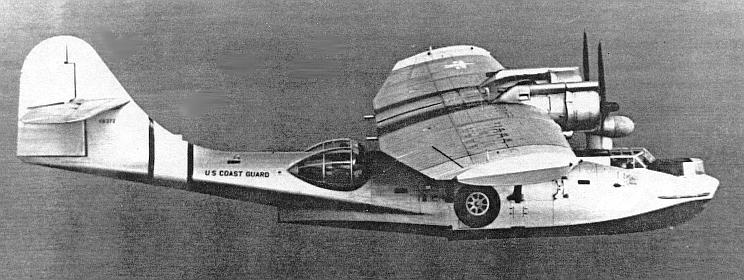
J. R. Lee, AOC, USCG, Retired Shortly after take-off Captain Burn declared an inflight emergency. Two of the Four engines had failed! Captain Burn reversed his heading to return to Isla Grande Airport. Troubles on the OC-4 multiplied. Unable to maintain altitude, Captain Burn informed the control tower he was ditching into the ocean approximately seven miles north northwest of Isla Grande. Isla Grande control personnel activated the rescue network, notifying the Search and Rescue (SAM) Center at U.S. Coast Guard Base, San Juan. The SAR commander put into action all Coast Guard resources, surface vessels and aircraft. At the adjacent Naval Air Station, Coast Guard Air Detachment Commander D. O. Reed ordered the emergency alarm sounded and the on-duty alert aircraft crew, under the command of Lieutenant Ted Rapalos, to launch the ready amphibious PBY-5A 46856 and proceed to the reported ditching site of Pan Am 526-A. PBY-5A 46586 was airborne in less than six minutes. Stand-by rescue air crew under the command of Lieutenant Commander Ken Bilderback readied PBY-5A 48429 which was undergoing routine maintenance. one major aircraft component, the auxiliary power unit (with its very important built-in bilge pump!), had been removed for overhaul. The gravity of the situation was such that the decision was made to launch the 48429. Within ten minutes the stand by aircraft and aircrew were airborne, on their way to assist in the search and rescue operation. Aircraft 46586 arrived at the reported ditching site and Lt. Rapalus began an aerial search. Visibility in the search area was good but the ocean surface was very rough. Fifteen knot winds whipped up white caps on the waves making it very difficult to see objects in the ocean waters. Air crew members on board 46586 located what appeared to be an oil slick with several shining objects but no signs of an aircraft, debris or, more important, survivors. Suddenly, a patch of orange smoke, the type used with aircraft inflatable life rafts, was spotted. Lieutenant Rapalus in Aircraft 46856 had located a life raft with thirteen survivors on board. Then two additional survivors were sighted. Smoke floats and florescent dye markers were quickly dropped at the scene to better mark the survivors' location in the rough ocean waters. No radio contact could be established so hand and wing signals informed the survivors rescue was on its way. Coast Guard 48429 arrived an scene to assist. Lieutenant Rapalus in 46856 remained airborne as the on-scene Rescue Coordination Commander while requesting Bilderback in 48429 to attempt a landing to rescue the survivors. Lieutenant Commander Bilderback and crew prepared 48429 for an open sea rough water landing. The wing floats were lowered into place, landing gear and all hatches were checked as secured in place and closed. An open see power-on landing into the rough seas up-wind of the life rafts and survivors was accomplished without incident. Bilderback now lowered the aircraft landing gear and streamed canvas sea drouges to improve the handling and stability of the amphibian in the rough seas as he maneuvered to drift down to the survivors. Reaching the two survivors in the open seas, he stopped the engines to prevent the whirling propellers from striking the survivors. The air crew members in the waist blister position struggled to get the survivors, a teenage girl and boy, into the pitching rescue aircraft. The large life raft contained
ten passengers, and three airline crew
members. They reported that many passengers
had panicked, refusing to leave the sinking airliner
to board the life rafts for fear of the rough seas
and the possibility of sharks known to be the area.
From his position at the front
of the PBY-5A, Co-pilot LCDR Jack Natwig saw the
difficulty Tierney was having battling the wind and
rough seas in his rescue raft, when suddenly the
young boy disappeared. Natwig opened his
overhead hatch and dove into the turbulent sea,
swimming to the young survivor. Holding the
boy tight, CDR. Natwig inflated his Mae West
life jacket to help provide buoyancy to hold the
both of them afloat. Increasing winds and
rough seas forced Tierney to abort his rescue
attempt and reboard 48429. Meanwhile, Natwig
and his young survivor were being rapidly swept away
From his aircraft. On-scene commander LT Rapalus requested AF SA-16 1023 to attempt a water landing and go to the aid of the drifting LCD Natwig and his young survivor, and a new survivor, the Pan Am pilot Captain John C. Burn who had been sighted some distance from Bilderback's PBY-5A 48429. AF SA-16 1023 responded successfully in the rescue of the three. Worsening sea conditions precluded a take-off and SA-16 1023 began a long taxi on the sea to the Naval Air Station, San Juan. From the air LT Rapalus recommended LCDR Bilderback in 48429 return with the survivors to San Juan's Isla Grande Airport while he continued an aerial search For additional survivors. None were to be found. Coast Guard PBY-5A 48429, now short a co-pilot, battered by rough seas and high winds and taking in water through the bow hatch and waist positions, made ready to take off with its survivors. Air crew member Bill Pinkston climbed into the co-pilot seat to assist pilot Bilderback. The removed auxiliary power unit was causing compound problems. Maintaining radio contact with the airborne Lt. Rapalus had seriously drained power from the aircraft batteries. To restart the engines it was necessary for air crew members Peter Eustes and Raymond Evans to climb atop the wing and manually crank the engine starters. Despite the hazardous conditions with rough seas often breaking over the wing, Eustes and Evans succeeded in restarting the engines. At this time the 180 foot Coast Guard Buoy Tender BRAMBLE (WLB392) arrived on scene with a doctor and medical personnel on board. As it continued to take on water, aircraft 48429 was in serious trouble from the battering of the rough seas. The decision was made to transfer the survivors still in the large raft to the BRAMBLE. After successful transfer in the airliner's life raft, the BRAMBLE later returned to shore with thirteen grateful survivors. The two teen age survivors remained with Bilderback in 48429. Sea conditions continued to worsen. PBY-5A 48429 was now overloaded with seawater. Pilot Bilderback aborted any further attempts to take off. A decision to either request assistance and abandon the aircraft or attempt to taxi on the sea back to San Juan Harbor had to be made. Bilderback, prior to becoming a Coast Guard aviator, had been a surfman used to handling surfboats in rough seas. His decision was to taxi 48429 back home. Through his and his crews' professionalism they had rescued sixteen of the seventeen survivors from a watery death, so taxiing home was all in a day's work. As Coast Guard PBY-5A 48429 taxied past old fort "El Morro" and into San Juan Harbor, the people of San Juan lined the shore cheering the valiant Coast Guard rescuers. There is an old ballad written by a local San Juan resident memorializing the lives lost in this watery tragedy and honoring the heroic rescuers of the survivors on this very sad Good Friday, 11 April 1952. Lieutenant Commander Ken
Bilderback was awarded his second Air Medal and LCDR
Jack Natwig received the Silver Lifesaving
Medal. Air Crew members Bill Pinkston, Jim
Tierney, Peter Eustes and Raymond Evans were all
commended by the Commandant of the Coast Guard for a
job well done. |
Copyright by Ted A. Morris, 1998
|