| THE OFFICE: | |
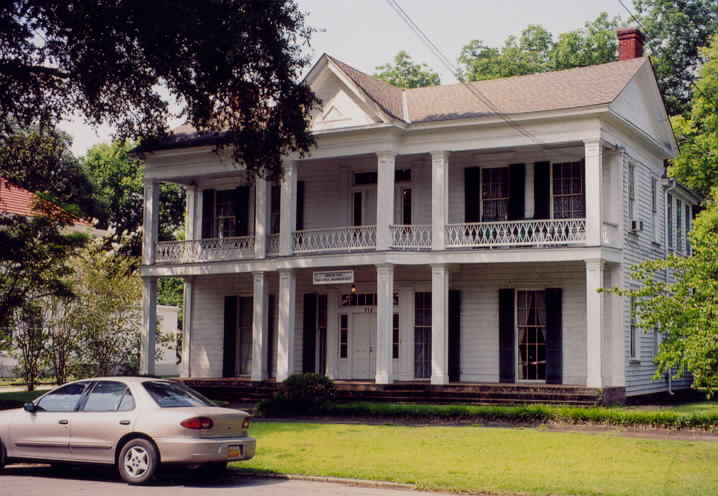 |
The Alabama Historic Commission acquired the old John Tyler Morgan homeplace for the offices of the "Center for Cahawba Archaeology". |
|
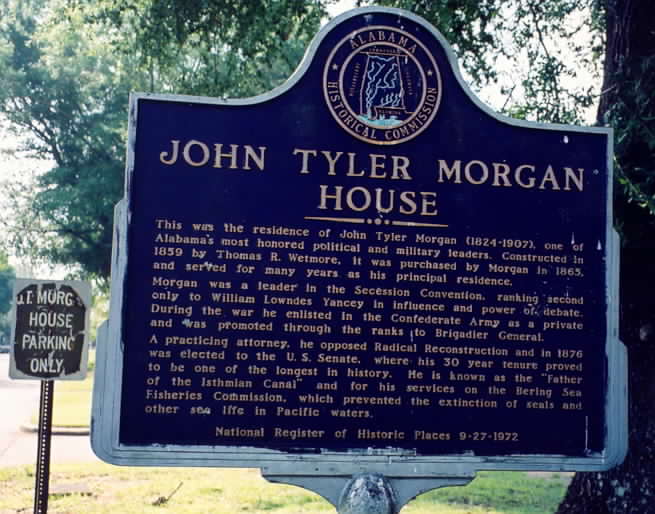
JOHN TYLER MORGAN HOUSE This was the residence of John Tyler Morgan (1824-1907), one of Alabama's mort honored political and military leaders. Constructed in 1859 by Thomas R. Wetmore, it was purchased by Morgan in 1865 and served for many years as his personal residence. |
 |
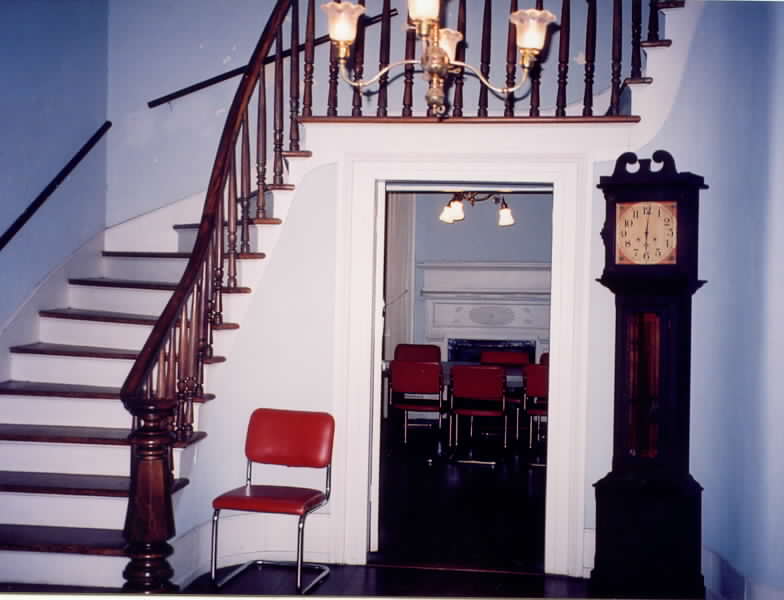 |
One enters through the foyer, graced by the beautiful staircase, clock, and chandelier. The hardwood floors and wood trim almost all original and very well preserved. A conference table in the dining room is surrounded by modest but comfortable seating for visitors, workers, and guests. |
|
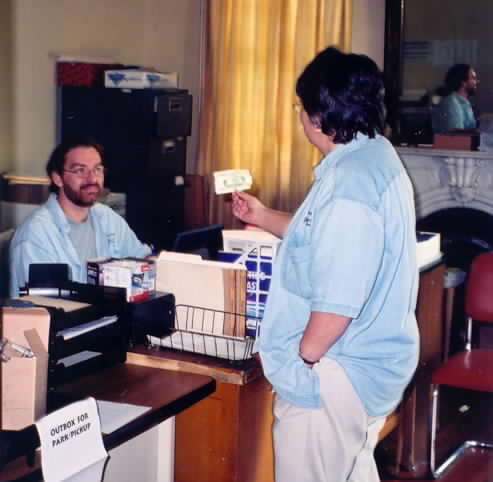
Off the foyer to the right is the parlor, which today
is Jonathan's office. He serves as everything from receptionist to right-hand
man to fill-in-the-blank--and all with a smile! (Real Cahawbans are glad
to serve!) Director Linda Derry speaks with him here about a business matter.
|
 |
 |
Ms. Linda Derry is the Director of the Cahawba Project and resident archaeologist, historian, and any number of other hard-to-fill positions. One of her highest priority goals right now is acquiring funds for the purchase of more land for the park. Years ago, private parties and other individuals bought parts of the town for their summer or winter homes, fishing camps, etc. When the Alabama Historic Commission created the Cahawba State Park several years ago and brought Linda on board as its director, the acreage owned by the park was much less than it is today, but thanks to her efforts, that acreage has greatly expanded. Nevertheless, the goal of putting all the town's land back into the custody of the park is still a long ways off, and with present budget cutbacks from the state, she's had to not only trim her staff of dedicated workers but also limit her own involvement in her first love of archaeological search and rescue and restoration. |
| . | |
| THE PARK: | |
|
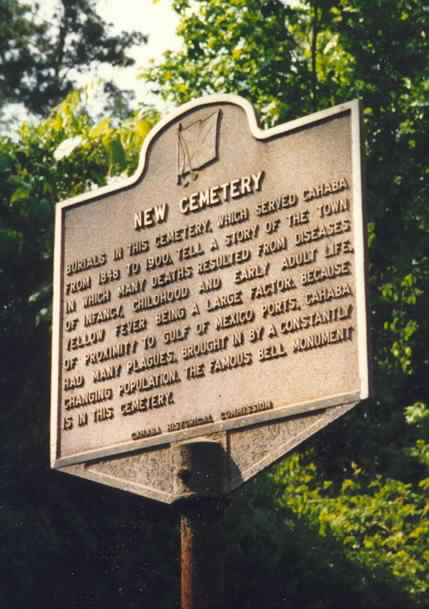
NEW CEMETERY
Alabama Historical Commission
|
 |
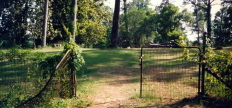 |
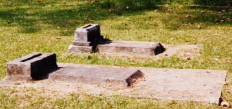
On the western edge of town lies this New Cemetery. Many of its denizens' graves are unmarked, many of the stones vandalized over the years. This holy ground is now well maintained, however, by the faithful staff of the Cahawba Project. |
|
While more than four of my kinspeople are likely buried
here, there are indeed four whose stones remain intact or partially intact.
My ggg-grandmother Jane Walker Gwin, was born ca. 1795, raised,
and married 12 Apr 1812 to John Gwin, all in Blount Co., TN. She
died sometime between 1864 (when she and her husband negotiated one of
their last real estate deals, and the 1870 census, when John alone was
living with their son and daughter-in-law, William and RoseAnn
Carlisle Jones Wilson Gwin, in Wilsonville, Shelby Co., AL. The stone
simply says,
|
 |
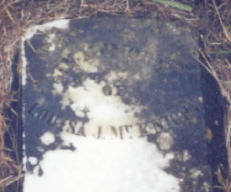  |
Buried just west of her is their youngest daughter, Louisa Gwin
McKnight, wife of William McKnight, and my own gg-grandaunt.
Like her mother's, this stone is also very succinct:
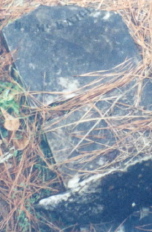
While there is no sign of his grave in that location, this portion of William's uprooted gravestone was found many yards away inside the fence surrounding Dr. Ulmer's and several others' graves. This leads me to believe that he is buried near if not next to Louisa. The remaining bottom of his stone lets us know that it is likely the same in style as the others: I speculate that all three graves were marked only with these marble
headstones;
It is my future desire to pour a similar or smaller slab west of Louisa's and mount this remaining piece of his stone upon it. I'd also like to pour a fourth slab to the north of all three and mount there a brass memorial plate with known vital information about all three. |
|
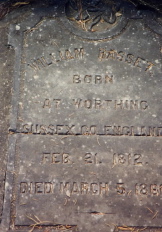
The grave of my gg-grandpa William Basset, whose
daughter Ida Eliza married John and Jane's grandson, William
Sutton Gwin, reads as follows:
BORN AT WORTHING SUSSEX CO. ENGLAND FEB. 21, 1812 DIED MARCH 5, 1866 He was a tailor by trade and is said to have made uniforms
for the confederate army. He is also said to have died of smallpox in Cahaba.
The grave of his widow, Harriet Bowley Basset, is said to be located near Tilden, AL in southwestern Dallas Co., next to that of their sons, James and John. |
  |