By Mark Mandelkern, K5AM
Published by the ARRL, NCJ, Jul/Aug 1998, 12-13; updated July 2026.
|
This 78 year project was not all
planned out from the beginning! In 1948,
as a 14-year-old kid in Wisconsin, with a new ham license,
I was trying to set up as W9ECV on a 25 cent weekly allowance.
Snow-shoveling jobs helped out in winter, and lawn-mowing in summer.
Even so, there was no hope of buying a factory rig. Thus my
one-tube transmitter and regenerative receiver were homebrew, built
using salvaged parts from large 1930s-style AM broadcast receivers. I
also used some military surplus gear, which was such a bargain at that
time. Converting this gear to ham use provided a good deal of technical
experience, mostly of the trial-and-error variety. But 10 meters was in
excellent condition, and the inexpensive war surplus receivers did not
tune that high. Necessity dictated the need for building a receiving
converter. That's when the homebrew bug first bit me for good. The result 78 years later is a totally homebrew contest station. At some point necessity ceased to be the driving force, but home-brewing continued because it was so much fun! Transverters, amplifiers and numerous gadgets followed for decades. By 1990 nearly everything in the shack was homebrew, only the transceiver stood in the way of a 100% homebrew station, so work began on a homebrew transceiver. |
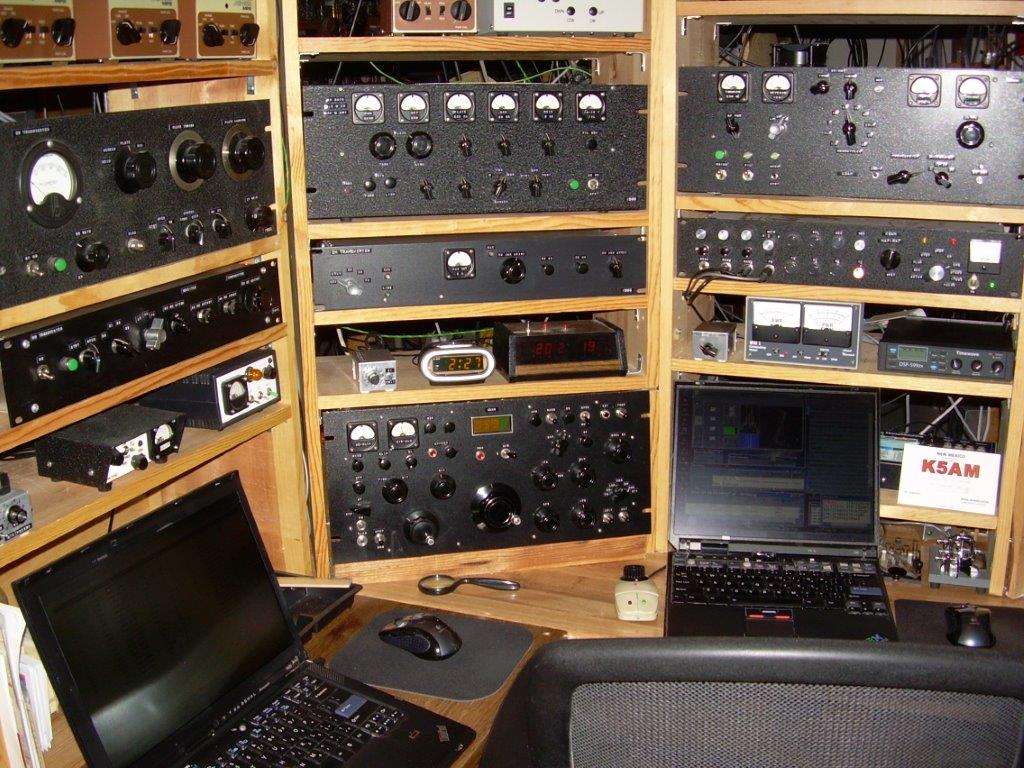
![[photo: k5am amplifier rack]](rack.jpg "K5AM homebrew amplifiers") |
|
The transceiver took three years to design and build; 1990-92. It has
dual VFOs, dual-receive, digital read-out, IF shift, RIT, RF speech
clipping and filtering, panel-adjustable CW offset, a 200 Hz CW filter,
a sensitive integrating squelch for 6 meter DX, a high-performance,
no-pop, no-click AGC circuit, a non-crunching noise blanker, and
QSK with no dit shortening, no lag, and 50 wpm break-in ability.
It uses 142 transistors, 189 integrated circuits, 236 diodes and
one 200 watt tube. No microprocessor, no synthesizer, and no
phase-lock loops; no phase noise, no spurs, and no birdies. The K5AM contest station operates at 1500 watts on everything from 160 meter DX to 2 meter moonbounce. The oldest piece of gear still in daily use was built while I was still in high-school in 1951: a small 6 meter amp, now used as a driver amp. My first 3 years of clumsy bread-boarding are sadly lost and not available for on-the-air use; this loss no doubt benefits nearby TV viewers. All the gear was newly designed and built from scratch. But I was not about to reinvent the superheterodyne. Each project begins with a thorough study of the handbooks and relevant magazine articles. I glean ideas from all previous builders, to whom many thanks are due. Design means selecting and choosing the best ideas which will help produce the intended results. Individual circuits are described in the handbooks; the real design work is to combine them into a complete functioning unit. Only a few circuits are truly new: a self-adjusting, splatter-stopping ALC circuit for tetrodes, an integrating squelch for 6 meter F2 monitoring, a non-crunching noise blanker, and a high-performance AGC system. These circuit designs have been written-up and published in ham radio magazines. The station is used in the most demanding situations: from 160 meter DX with weak signals and high noise levels, to Sweepstakes on 20 meters with heavy QRM, to VHF contesting with rock-crunching local signals, and to 2 meter moon-bounce work with infinitesimal signals. Each piece of gear is subject to continual testing, update and improvement. Building simple gear for casual operating and cross-town rag-chews is a fine way to get started in home-brewing and to gain design experience. I soon discovered, however, that achieving state-of-the-art, contest-grade performance is a totally different ball game. The gear is built on 19 inch black rack panels. The large heavy amplifiers are stacked in the 6 foot rack. No attempt is made at miniaturization; ample space is allowed in each item for shielding and filtering, and for future modifications and improvements. With hinged boards and other devices, provision is made for easy servicing and experimentation. I did receive some essential help in building this gear: one difficult problem was in laying out the panels to achieve a pleasing appearance. Luckily, my XYL Lisa is a graphic artist, and most of the panels were designed with her assistance. There is also another, more rigorous, conception of home-brewing. Some truly amazing hams also design and build their mikes, keys, headphones, CW memory keyers, paddles, voice recorders, towers, antennas, rotators, RF power meters, DSP filters - even test gear and vacuum tubes! To leave ample time for my day job, and for working DX and contests, I had to compromise. All those accessory items I buy ready-made. I like building the major items on the rack panels, and find the RF and circuit work intriguing. Lack of test gear is often thought to be an insurmountable hurdle to home-brewing, but it needn't be. The station was mostly built and aligned using inexpensive WWII surplus and Heathkit test gear. Today, top-of-the-line, although older, HP test gear is available for reasonable prices; the test gear in my shop is now mostly this sort of bargain HP gear. Formal training is not required, either. I've never taken a course in electronics, but the handbooks have all the required information. Nor are fancy computer programs needed. Home-brewing, even for serious DX and contest work, is not like advanced development work. All the required formulas are found in the handbooks; they involve no more than the simplest high-school algebra. In the old days, the sliderule was as important a tool as the soldering iron, but now calculations are easily done by a small programmable calculator. Does this station come out on top in every contest? No, hardly ever. Devoting so much effort to building the rigs leaves little time for planting a "big gun" antenna farm. I am quite content to be one of the "little pistols" and just have fun. A contest is a merciless test of the equipment; I feel like a winner if none of the homebrew gear breaks down during a contest, and in 78 years it never has. The June VHF contest is my favorite; I hold the section and division top-score records, and several times blasted through the eastern monopoly to win a place in the top ten. On HF, my best effort was a division sticker for the ARRL SSB DX contest, way back when it was a 96 hour two-weekend marathon. In the moon-bounce contest, with only a single 2 meter yagi aimed at the horizon for moonrise and moonset, being in the top ten would be an absurd dream, but recently I finally achieved my long-standing goal and got out of the bottom ten. Ham radio and home-brewing greatly influenced my career choice. At a very early age I built a battery-operated one-tube receiver; it was beautiful, but it didn't receive anything! I looked for information on receivers at the local library, but found the formulas in the electronics books bewildering. That kid sure wanted that receiver to work, so he had to teach himself algebra. Thus ham radio, contesting and home-brewing were crucial steps to college on a Navy scholarship, three years at sea as a deck officer, graduate school, a PhD, and a university research career as a professor in pure mathematics. Ham radio provided a serious challenge to high-school kids in the 1940s. Young people need serious challenges to capture their enthusiasm and steer them in worthwhile directions. The ham radio challenge in the 1940s was technical; no easy paths were obligingly laid down. The exams were tough and required schematic diagram drawing; entry level was 13 words per minute. A ham ticket required a serious effort, and was considered a highly-valued accomplishment. Are there more projects planned for the K5AM workbench? A few possibilities, perhaps. But for now, planned improvements to the existing gear will keep me busy for several years. Also, I've recently come down with a bad case of boatanchor fever. My BC-348, ART-13, HRO-5, HQ-129-X, 75A-4, 51J-4, 51S-1, KWM-2, DX-100, Harvey-Wells, Ranger, 6N2, Gonset G-50, Yaesu FT-620, and five 6 meter Clegg rigs all need time and TLC. Recently I've spent time at a VHF contest site at 7900 feet on Horse Mountain, in DM54. Since the homebrew gear is too heavy to haul, the mountain station uses modern, factory-built gear. Yes, all the bells and whistles are great fun. Then why am I always so happy to get back home and operate the old-fashioned homebrew gear? It performs better!
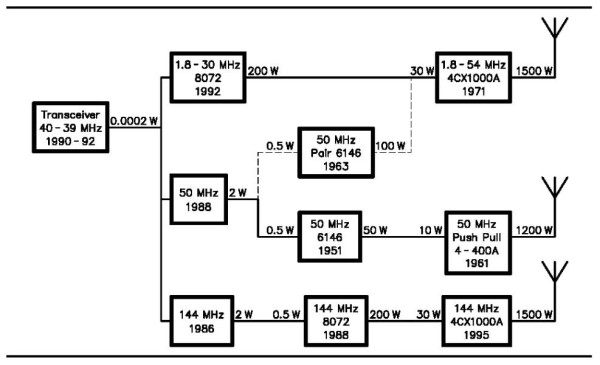
To obtain the cleanest signal possible, the station uses class A transistor stages up to 2 watts, and then only tubes, class AB1 tetrodes. The diagram indicates the power available from each unit and also the lesser power required by the next. The resulting headroom yields the best IMD performance. Overall gain is controlled at the milliwatt level in each front-end section. To prevent splatter, ALC runs from each driver and each high-power amplifier back to the corresponding front-end panel, with ALC metering at the transceiver. There are no diodes in the signal path at any point in the station. The 8072 is a conduction-cooled tetrode, identical to the well-known 8122 except that the 8072, with no air-cooling fins, clamps onto a heat sink. The neutralized 8072 driver amp for 2 meters has 26 dB gain. The Eimac 4-400A bottles used in push-pull on six meters are the originals, 65 years old and still running at full output - that's Eimac! |
 1984
1984
|
Mark Mandelkern, K5AM, was issued his first ham license, W9ECV, in 1948, at age 14; at that time, the exam for a first ham license required copying Morse code at 13 words per minute and drawing schematic diagrams. Mark's main ham operating activity is 6 meter DX, with 147 countries worked, using only CW and SSB. He also enjoys HF DXing, with DXCC confirmed on 10 bands; and contesting, with several top-ten contest awards. Mandelkern is a professor of mathematics emeritus at New Mexico State University. |