The terminated folded dipole (TFD) is an HF folded dipole antenna with a non-inductive terminating resistance opposite
the feedpoint. This scheme provides for a broadband no-tune antenna over a wide range of frequencies. Commercial versions maintain
an SWR of 2.5:1or less from 80M (3.5 MHz) to the 10M (28 MHz) ham bands. Both my 66 ft. and 133 ft. long TFDs work very
well with <1.5:1 SWR most bands. (see below).
No antenna is the perfect antenna.
A TFD (or T2FD) is not for everyone.
You'll need some back yard real estate. Not for HOAs. It is harder to build over most other wire antennas. It does take some piddling
with wire lengths and the terminating resistor for lowest SWR on all bands. Once properly built and tuned, it is a a very good
no-tune
antenna for quick band changes with no antenna tuner. With mine I have worked Europe to Asia and Oceana countries with 5 watts
QRP.
But ... If you want to read how worthless a TFD antenna is — read about them on the internet. All these antenna
gurus have computer modeled them to claim a useless antenna, a glorified dummy load or worse, and certainly worthless for QRP.
Of course, they've never actually used one. TFDs have been used by the military, U.S. Navy, submarine service, and
embassies, but for some reason, claim they are worthless for ham radio.
For a different perspective, see L.B. Cebik,
W4RNL (SK) analysis:
Discussion. Building a TFD is not for the faint of heart. It takes considerably more effort and hardware than building
a simple dipole. Especially if you don't have tall trees. I've built several of them experimenting with different dimensions.
My first TFDs were based on the commercial lengths, such as the Yaesu YA–30 (length 83 ft.) or Bushcomm SWC-100C (78 ft., or an astonishing
157 ft. length). I made QRP QSOs with these lengths, but SWR minimums were near the 4, 8, 12 and 17 MHz maritime bands, not ideal
for the ham bands.
One of the major complaints of the TFD is the amount of RF power dissipated in the terminating resistor
(Rterm), common at these non-resonant lengths on the ham bands. My first TFD was 66 ft. long, resonant for
40M. The maximum current and minimum voltage at the feed, I reasoned, would also be seen at the terminating resistor, opposite
the feed. Maximum voltage is minimum power dissipated by Rterm, confirmed by building an RF detector and LED to visually show
the power across Rterm. Turns out making the TFD resonant for minimal Rterm loss is the approach B-Squared Engineering uses
on their amateur radio TFDs.
The 66 ft. length, and
later a 133 ft. length TFD, moved the SWR minimums to the desired ham band frequencies. I reduced the power dissipation
and lowered SWR further by raising Rterm to 820 ohms as B Squared found best, and building a 16:1 balun at the feed for
the 50-to-800 ohm matching. Most commercial TFDs use a 300 ohm feed line and 390 ohm termination, or with 50 ohm coaxial feedline,
a 9:1 balun for a 450 ohm terminating resistance.
Current configuration and results. My current TFD is 133
ft. long and 28 ft. above ground. It has low SWR, 1.5:1 or less, on the ham bands, and reasonable on the WARC bands except 24
MHz and upper end of 10M and 160M. It's advantage over the 66 ft. TFD is better performance on 80M. With "more wire
in the air," there is some improvement in weak signal sensitivity. My transceivers are connected to the TFD directly, no antenna
tuner is used. Signals are about the same on the TFD as a dipole or G5RV, if not a bit less. However, the TFD is a much quieter
antenna, usually about 2 S-units less noise than the dipoles or vertical, yielding a better signal-to-noise ratio on receive. The
two wire runs on my TFD are 16" apart using 1 inch O.D. PVC spacers. I found little difference experimenting with different
spacings, (tried 24 and 32 inches) or height above ground. In the New Mexico desert, I have no idea where electrical ground
is. I'm on well water, with water 220 ft. down the hole if that's any indication of electrical ground.
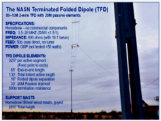
The NA5N Terminated Folded Dipole (TFD)
2018: Built 66 ft. version for 40M–10M.
Wood masts built of 2x4s and 2x2s, 26 ft. tall.
There are no trees in the New Mexico desert.
2023: Propane truck backed into a guy wire
bringing down north support mast and the TFD.
There was tangled wire everywhere.
Poor
fella felt awful. So did I.
2023: Rebuilt with 133 ft. length using 30 ft. metal support poles in concrete bases. Good performance on 80M. Sunset
shot to better show wire elements.
TFD 66 FT.
40–10M VERSION
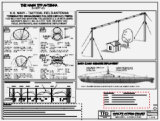
TFD 66 FT. VERSION
PHOTOS & DETAILS
TFD 133 FT.
80–10M VERSION
AS-BUILT INFORMATION & PHOTOS
SHORE STATION NA5N
Socorro, New Mexico
I am 99% QRP and 100% CW. Been a ham since 1964. My modest station consists of a modified Ten Tec Scout (purchased from the Ten Tec
factory 1994) still going strong and simple, a joy to use, and a great receiver. Set at 5 watts most of the time, though I turn
up the wick to its QRO 50W max on rare occasions.
Antennas are the 133 ft. long
TFD and a 5BTV trap vertical with 36 radials. This combination of horizontal and vertical polarized antennas is sometimes very advantageous
as one can have a 3 S-unit difference switching between polarizations. The ionosphere does that.
I am active in various QRP events
and SKCC, the Straight Key Century Club (I am #10073S). My favorite mechanical key is my 1938 McElroy bug or "Mac key."
72/73,
Paul NA5N
NA5N@zianet.com
I'd be glad to hear from you and your experiences building and/or using a TFD antenna on the ham bands, or if you have any questions.
72,
Paul
History. The TFD was developed by the U.S. Navy during WWII. During the war, the Germans and Japanese became quite efficient
in locating allied ships and planes using HF direction finding systems. A transmitting vessel could be located by triangulation
in about 15 minutes. To counter this threat, transmissions were kept short (5-10 minutes) and changed frequencies often. The
problem with this frequency-hopping tactic was the time it took to "tune" antennas from one frequency to another. Often several
minutes ... time that pertinent communications could not take place.
Submarines were particularly vulnerable since most operated
"lone wolf" with no escorts for protection. To avoid visual detection, they charged their batteries only at night.
While surfaced, they also transmitted required position and operation reports risking radio detection. Locating a submarine surfaced
with depleted batteries meant certain destruction. To avoid direction finding detection, rapid frequency changes were enacted
while transmitting messages. However, it took time, several minutes in poor weather, to retune their short end-fed wire antennas. The
Navy developed the broadband TFD for transmitting that allowed almost instantaneous frequency changes without retuning,
even hops of many MHz. Separate antennas were used for transmitting and receiving on separate frequencies for additional security.
After
the war, one of the Navy TFD developers, Capt. Gil Countryman, W3HH, published an article in the June 1949 QST presenting the
design and the suitability for amateur radio use. It worked reasonably well as a no-tune antenna on the ham bands, even
though dimensions in the article were based on the Navy design optimized for military, aeronautical and maritime frequencies.
Unfortunately, these military dimensions have remained prevalent in most amateur radio TFD literature, forcing many to criticize
their reduced efficiency on the ham bands.
2024: Rebuilt center feed placing items on a plate. Homebrew 16:1 balun and feed in sealed box on left, termination
resistor mounted in sealed box on right and a "poor man's" common mode coaxial choke on plate. Reduces weight
slightly for less sag and easier to modify balun and termination.
Are we having fun yet?